
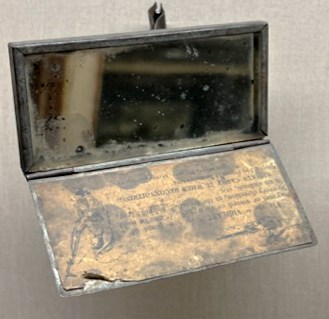
This hinged trench mirror, sold under the name “Vigilant,” was a simple but potentially life-saving observation tool developed in the early months of the First World War. In trench warfare, even lifting a soldier’s head above the parapet could be deadly, and this small mirror helped soldiers see without being seen. Small, clever ideas could save lives, and ordinary objects were adapted for extraordinary dangers. Measuring 2 inches (5.08 cm) by 3.5 inches (8.89 cm), it was designed to clip onto the point of a bayonet, a sword, or to be mounted on a short stick.
Its purpose was straightforward: allow a soldier to see over the top of a trench or around cover without exposing his head or body to enemy fire. By raising only the rifle or stick above the parapet, the mirror reflected a forward view while the soldier remained safely below cover. This was especially important in trench warfare, where snipers constantly watched for even the smallest movement.
When not in use, the mirror folds closed on its hinge. This protected the mirror surface from damage and reduced the risk of sunlight reflecting off the glass and giving away a soldier’s position.
Manufacturing and Design
The “Vigilant” was a commercially produced invention developed very early in the trench warfare period. It was patented in France on 14 November 1914, only months after trench systems became widespread on the Western Front. This rapid appearance highlights how quickly manufacturers responded to the new dangers of static warfare.
This example is constructed from wood and glass mirrors, with a hinged design that allows the mirror to be closed when not in use. Other surviving examples show metal-framed versions, suggesting that the Vigilant was produced in more than one material or pattern.
The instruction card identifies Saint-Ovin, France as the place of manufacture and includes the name Boel. While the name resembles that of modern firms using “Boel” in their branding, there is no reliable evidence linking this First World War manufacturer to any present-day company such as “Boel Manufacturing” or “Boel Technologies.” On current evidence, Boel should be understood as a local early-20th-century French manufacturer or workshop, not a verified corporate ancestor of a modern firm.
Scale of Issue and Use
Trench mirrors like the “Vigilant” were not standard-issue equipment at the beginning of the war. They were typically privately purchased by soldiers or acquired informally by units, particularly for scouts, observers, and patrol leaders. Their small size made them easy to carry and share within a section.
They were commonly used during:
- Reconnaissance and patrols
- Observing No Man’s Land
- Checking enemy wire or forward positions
- Ambush preparation
- Looking around trees, ruins, or trench corners
As the war continued, the usefulness of these devices led to the formal adoption of similar designs, and the Vigilant concept evolved into officially recognized trench periscopes in British service.
Evolution and Later Developments
Early trench mirrors such as the “Vigilant” were among the first practical responses to the deadly problem of observation under fire. Over time, these simple mirrors were supplemented and replaced by:
- Longer trench periscopes
- Fixed observation periscopes built into trench systems
- Improved protected viewing devices in later fortifications
Despite these developments, the core idea never changed: see without being seen—a principle still used in modern military optics and surveillance equipment.
Manufacturer’s Instructions (from attached card)
Fix the “VIGILANT” on the point of a bayonet or sword or on a stick.
It can be used in every direction, in the trenches or behind a tree, in an ambush, etc.
ALWAYS CARRY IT WHEN RECONNOITRING
Markings
- Name: VIGILANT
- Checked by inspector: 20
- Copyright: France, 14 Novembre 1914
- Manufacturer / location on card: Boel, Saint-Ovin, France