
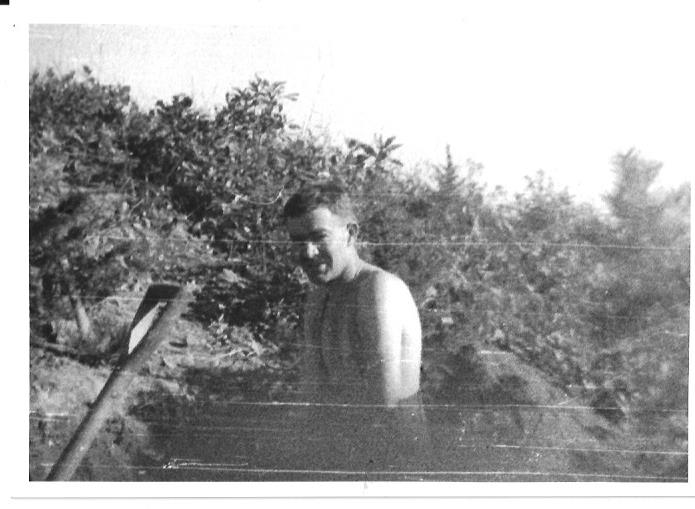
Art Johnson digging a trench in front of 166, Korea 1951, P1601
Korea, 1950-1954
In June 1950, surprise attacks by North Korea along the 38th Parallel brought a return of war in Korea. Following the United Nations appeal, the Canadian government decided to raise a force, the 25th Canadian Infantry Brigade, to take part in the action. Following calls to the militia for help, Sergeants Art Johnson and Archie MacMillan of the 48th Highlanders signed on for call-out duties. Enlistment for the Canadian Army Special Force (CASF) began at once and by the end of August, with everyone working seven days a week, they had processed 2,075 volunteers and eliminated the backlog.
The mobilization orders also allocated call-out numbers to reserve units. The 48th allotment was twenty-three plus an officer. Lieutenant J.A. Cowan, who had joined the regiment after serving in the 48th Highlanders Cadet Corps, and twenty-three men, including Sergeant Johnson, at once volunteered and would become members of The Royal Canadian Regiment. Nineteen other Highlanders signed up as individuals to serve in a variety of units. At least seven more, who had joined the regular force following service overseas with the 48th in the Second War, went to Korea with the brigade. Among them was Sergeant A.J. Gauthier, who won the Military Medal on the advance to Rimini and Major Rod Davenport, signals lieutenant at the Pachino landing in Sicily. The 25th Canadian Infantry Brigade trained for a brief time in the United States, at Fort Lewis, Washington before being committed to Korea in May 1951.
In the spring of 1954, late in the Korean War, a third group of sixteen Highlanders, including Major John Clarke who had won the DSO for his leadership on Cemetery Hill west of Ortona, arrived in Korea. These Highlanders had joined the 2nd Canadian Highland Battalion, 27th Canadian Infantry Brigade located in Canada whose role was to provide replacement troops for Germany. By 1953 the Korean need was greater and the unit was re-badged Black Watch before being sent to Korea in the waning period of that war. Of 48th Highlanders who fought in Korea, two were severely wounded: both Sergeant A. Johnson and Private T. MacKay lost a leg.