
Where to find them
The colours of the Regiment that are no longer in use are hanging on both sides of the chancel.
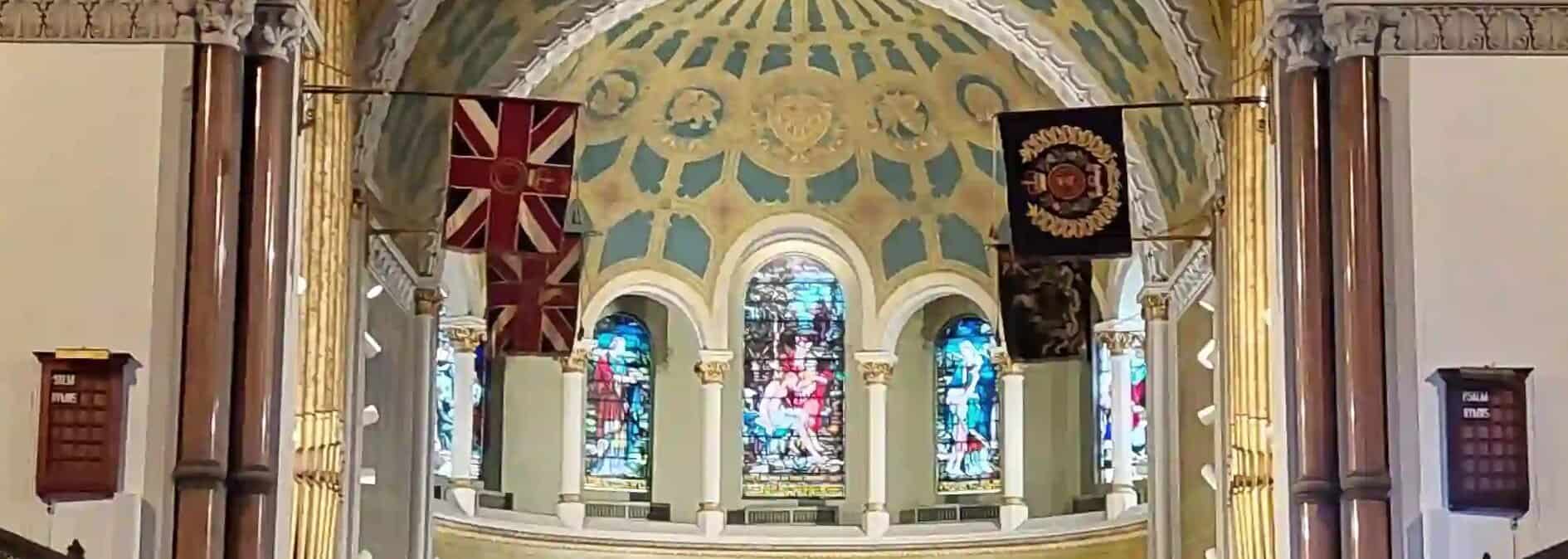
The Colours on this page are not just old flags hung high out of the way. For the 48th Highlanders, they are the Regiment’s honour made visible – carried on parade in their prime, then brought here to St Andrew’s, the regimental church, to rest among the people they represent.
What are the Regimental Colours?
In the Canadian Army, infantry units like the 48th Highlanders are traditionally presented with a Stand of Colours, made up of two flags:
King’s/Queen’s Colour (Sovereign’s Colour)
This Colour represents the monarch and the nation. It carries the sovereign’s crown and the regimental numeral or designation in the centre. Since 1985, the Sovereign’s Colour has been based on the Canadian flag, incorporating the St. Edward’s Crown and the Royal Cypher.Regimental Colour
This Colour bears the unit’s crest and is inscribed with the names of battles in which the unit has distinguished itself, known as battle honours.
Click HERE to see a list of the battle honours awarded to the 48th Highlanders. For most of them, a brief summary of the battle is available.
Colours are sacred to current and former members of the Regiment. They are presented during a special ceremony by a member of the Royal Family or a high-ranking representative of the Crown, and they are treated with the same respect as would be given to a living symbol of the Regiment itself.
The Four Stands of Colours
Over its history, the 48th Highlanders of Canada has received four stands of Colours. Each stand marks a chapter in the Regiment’s service.
Stand 1 – The First Colours
The Regiment’s first stand of Colours served through its early years and the great trials of the early 20th century. When they were retired, they were laid up and later moved for preservation.
Today, Stand 1 is displayed in the 48th Highlanders Museum downstairs, where visitors can see them up close and trace the earliest battle honours of the Regiment.Stands 2 and 3 – The Colours above you
The second and third stands of Colours were carried by generations of Highlanders on parade and on service at home and abroad.
These stands have now been laid up in the chancel of St Andrew’s Church, hanging above the sanctuary. When you look toward the front of the church and see the faded silk and embroidered honours, you are looking at Colours that once marched in step with the Regiment.Stand 4 – The Colours still on parade
The fourth stand of Colours is the current, living stand. These Colours are still carried on ceremonial parades by the active battalion of the 48th Highlanders.
They are not yet laid up here in St Andrew’s because they remain in active service. When the Regiment parades through Toronto on major occasions, it is this stand that leads them.
This page, and this part of the tour, focuses on the retired Colours – the stands that have completed their duty and now rest here in the Regiment’s church or in the museum directly below.
“Laying Up” the Colours
When Colours are no longer fit for use – either because they are physically worn or because a new stand has been presented – they are never thrown away or quietly stored out of sight. Instead, an old stand is “laid up” in a place that has deep spiritual and historical meaning for the Regiment.
For the 48th Highlanders, that place is St Andrew’s, their regimental church.
The laying up of Colours is marked by a formal ceremony:
The Regiment parades the outgoing Colours one final time.
The Colour party marches into the church, usually as part of a special service.
The Commanding Officer and Chaplain take custody of the Colours and commit them to the care of the church, dedicating them as a lasting memorial to the Regiment and its dead.
The Colours are then placed in their permanent position – in this case, high in the chancel, overlooking the congregation.
Once laid up, Colours are never again carried on parade. They are left to hang until time, dust, and sunlight finally take their toll. The fading of the silk and the fraying of the embroidery are not seen as neglect, but as a visible sign that the Colours have “grown old” in the Regiment’s service, just as the soldiers they once led have grown old or passed on.
When laid-up Colours eventually decay beyond saving, their remains are usually taken down quietly and disposed of with dignity – often by burning on consecrated ground – much like the respectful disposal of a national flag.
A Living Line from Past to Present
Here in St Andrew’s, the laid-up Colours of Stands 2 and 3 watch over the pews, the pulpit, and the memorial plaques that record the names of Highlanders who served and fell. Stand 1 is preserved in the museum downstairs as the starting point of that story. Stand 4 is still out on the street and on the parade square with the active battalion.
Together, they form an unbroken line:
from the Regiment’s earliest years,
through two world wars and decades of peacekeeping and service,
to the Highlanders who still march behind the Colours today.
As you stand in this church, you are standing in the same place where past generations saw these Colours presented, blessed, and laid up. They are more than decorations: they are the Regiment’s honour, entrusted to this building and this congregation to be remembered and respected – faithful forever.