29 -

Mess dress and piper’s uniform

Location: At the far end of the south aisle near the window wall.

Artifacts

Below are the records relating to the artifacts in this display. Tap/click to open the detailed description. For some displays we have Recommended particular artifacts. 

ImageTitle
Full Dress Review Order Uniform – Piper – 1932 Recommended
Mess Dress – Regimental Sergeant Major – 1923 – 1954 Recommended
Change of RSM – WO1 F. Wigmore, MM, CD from WO1 G. Stephen – 1951
RSM G.M Stephen Miniature medals
WO 1 Frederick Wigmore Miniature Medals

Audio guide

(85 seconds)

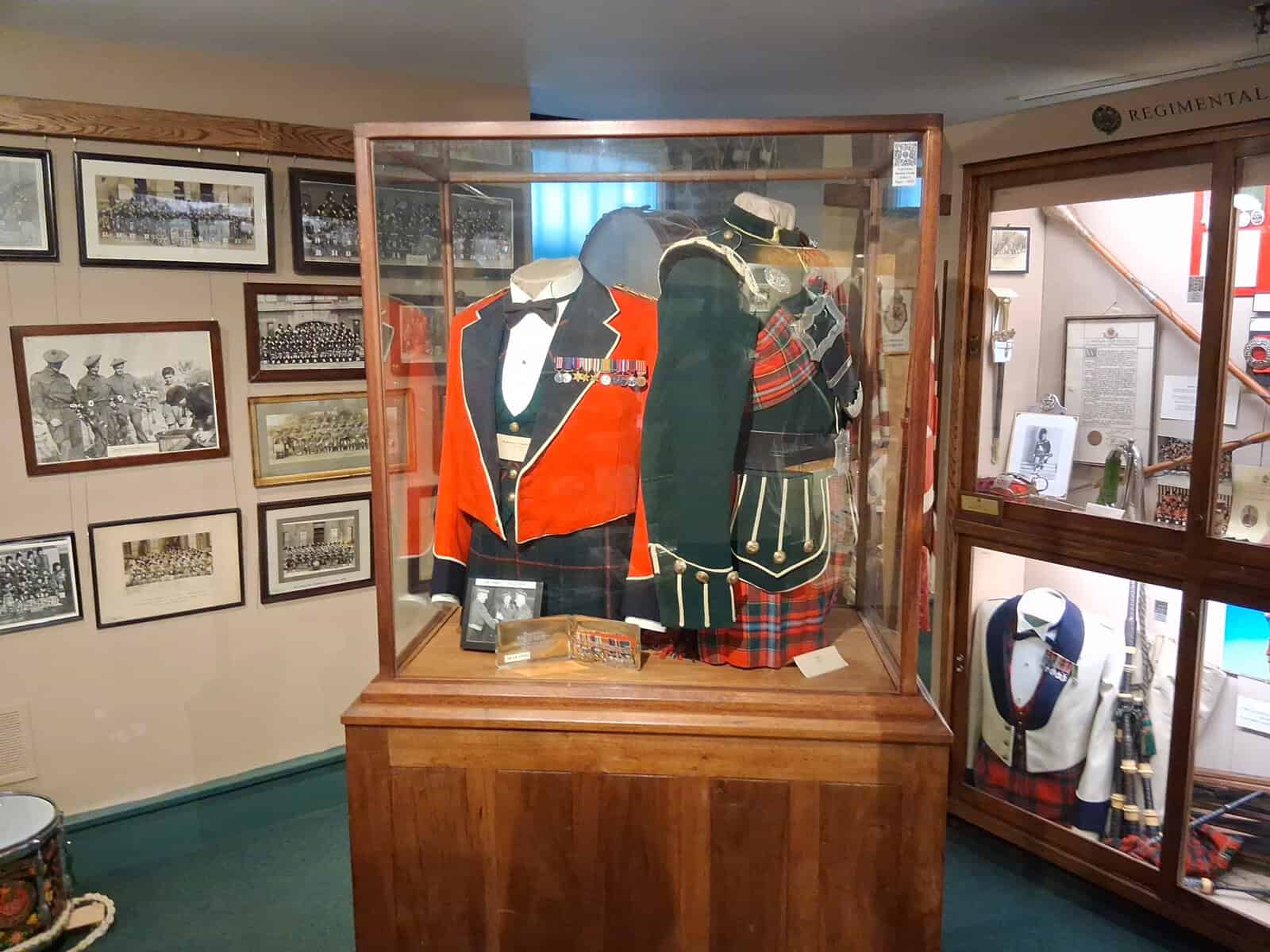
These two uniforms show two remarkable parts of the 48th Highlanders of Canada’s ceremonial tradition: mess dress and the pipers’ full dress. Walk around the case and take in both.

Mess dress is the regiment’s formal evening uniform, worn by officers and senior NCOs at regimental dinners, ceremonial banquets, and social functions. Picture the mess on dinner night: good food and drink, the pipes sounding, toasts raised, and comrades sharing stories. It is a gathering of the age-old traditions that Highland regiments have kept alive for generations. The scarlet jacket with dark blue facings is a hallmark of Commonwealth Highland regiments, adapted by the 48th Highlanders after their formation in 1891. The waistcoat and kilt are in Davidson tartan, the regimental tartan worn by all ranks except pipers. This particular example is distinguished by gold shoulder cords, identifying it as the mess dress of either a senior Warrant Officer, such as a Regimental Sergeant Major (RSM), or an officer. The miniature medals belonged to Warrant Officer Class 1 (WO1) Frederick Wigmore, MM, CD, who became Regimental Sergeant Major (RSM) after WW 2.

It is important to note that RSM is not a rank but an appointment—the senior-most warrant officer of the battalion. The RSM is responsible for regimental discipline, drill standards, and advising the commanding officer on soldier welfare and traditions. It is the pinnacle of a non-commissioned soldier’s career and carries immense respect within the regiment.

The pipers’ full dress is one of the most distinctive uniforms in the Canadian Army. The green doublet with elaborate silver braid and shoulder wings is traditional for pipers. Notably, the kilt here is Stewart of Fingask tartan, unique to the 48th Highlanders’ pipers, which makes them immediately recognizable on parade. Imagine the piper who wore this uniform, marching at the head of the regiment with the pipes skirling, and behind him the troops in scarlet full dress. Picture the spectacle: the sound, the colour, and the pride of a regiment on parade.

Mess dress and piper’s uniform

Audio guide

(85 seconds)

These two uniforms show two remarkable parts of the 48th Highlanders of Canada’s ceremonial tradition: mess dress and the pipers’ full dress. Walk around the case and take in both.

Mess dress is the regiment’s formal evening uniform, worn by officers and senior NCOs at regimental dinners, ceremonial banquets, and social functions. Picture the mess on dinner night: good food and drink, the pipes sounding, toasts raised, and comrades sharing stories. It is a gathering of the age-old traditions that Highland regiments have kept alive for generations. The scarlet jacket with dark blue facings is a hallmark of Commonwealth Highland regiments, adapted by the 48th Highlanders after their formation in 1891. The waistcoat and kilt are in Davidson tartan, the regimental tartan worn by all ranks except pipers. This particular example is distinguished by gold shoulder cords, identifying it as the mess dress of either a senior Warrant Officer, such as a Regimental Sergeant Major (RSM), or an officer. The miniature medals belonged to Warrant Officer Class 1 (WO1) Frederick Wigmore, MM, CD, who became Regimental Sergeant Major (RSM) after WW 2.

It is important to note that RSM is not a rank but an appointment—the senior-most warrant officer of the battalion. The RSM is responsible for regimental discipline, drill standards, and advising the commanding officer on soldier welfare and traditions. It is the pinnacle of a non-commissioned soldier’s career and carries immense respect within the regiment.

The pipers’ full dress is one of the most distinctive uniforms in the Canadian Army. The green doublet with elaborate silver braid and shoulder wings is traditional for pipers. Notably, the kilt here is Stewart of Fingask tartan, unique to the 48th Highlanders’ pipers, which makes them immediately recognizable on parade. Imagine the piper who wore this uniform, marching at the head of the regiment with the pipes skirling, and behind him the troops in scarlet full dress. Picture the spectacle: the sound, the colour, and the pride of a regiment on parade.

Links

Artifacts

Below are the records relating to the artifacts in this display. Tap/click to open the detailed description. For some displays we have Recommended particular artifacts. 

ImageTitle
Full Dress Review Order Uniform – Piper – 1932 Recommended
Mess Dress – Regimental Sergeant Major – 1923 – 1954 Recommended
Change of RSM – WO1 F. Wigmore, MM, CD from WO1 G. Stephen – 1951
RSM G.M Stephen Miniature medals
WO 1 Frederick Wigmore Miniature Medals
↑
Subscribe
Notify me of
0 Comments
Oldest
Newest

Holiday closure

We will be closed on Saturday, July 25, 2026 and will reopen on Sunday, July 26, 2026.

While the museum is closed, our Digital Guided Tour is still open. It is the best way to explore the museum from home, with stories and context for selected displays.

You can also take our 360° Virtual Tour for a visual walk-through of the museum rooms and display cases.

We will try to respond to your email messages as soon as possible.