53 -

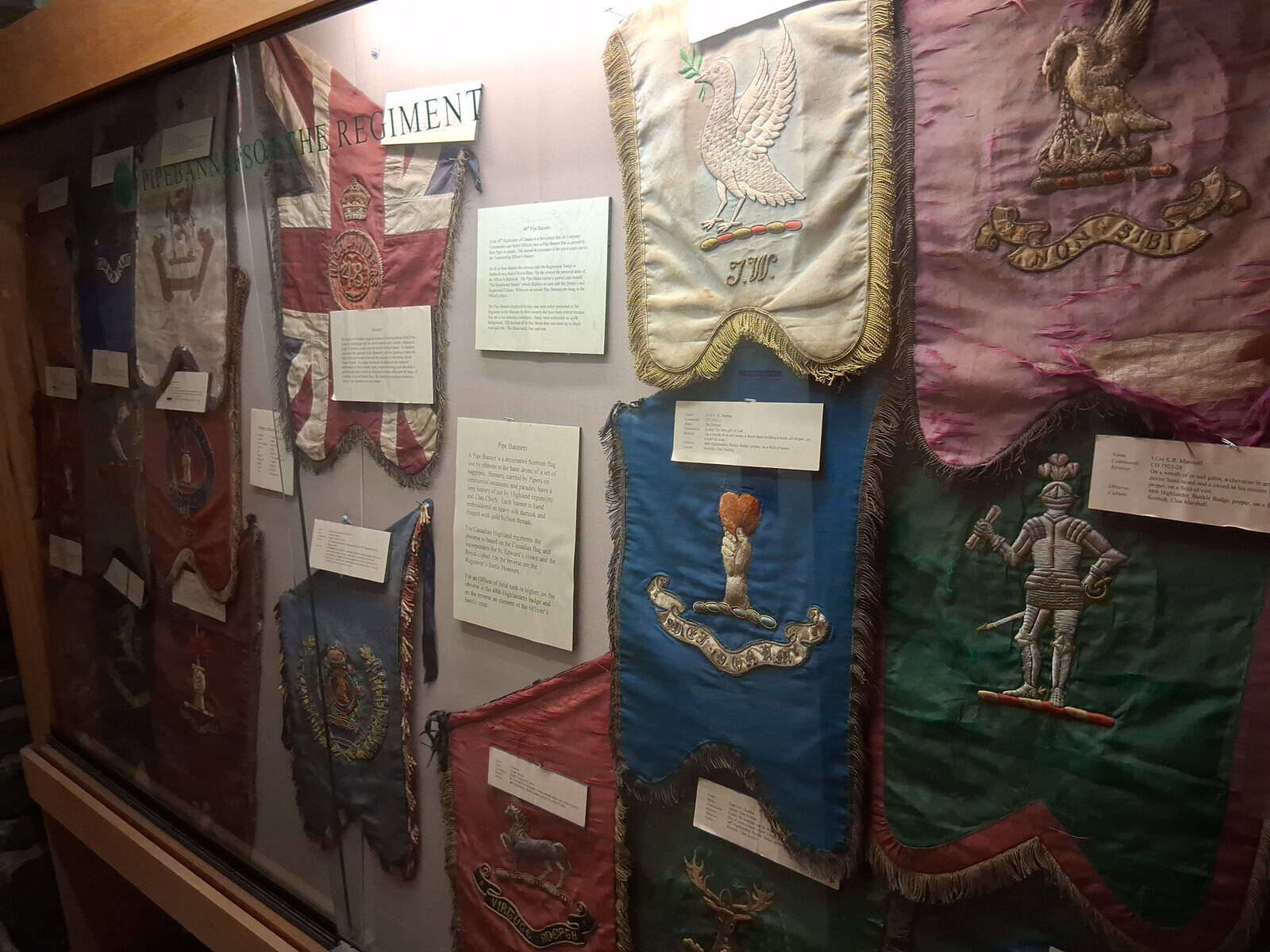
Pipe Banners

Location: A bit out of the way but you will find this interesting display at the far end of the Ante Room away from the stairs.

Artifacts

Below are the records relating to the artifacts in this display. Tap/click to open the detailed description. For some displays we have Recommended particular artifacts. 

Pipe banners are elaborately embroidered flags or pennons attached to the bass drone of a bagpipe, carried by pipers in Highland regiments and civilian pipe bands. Rich in symbolism and tradition, these banners have become important ceremonial and heraldic items within Highland culture.

In Scotland, a banner or standard was an essential emblem of authority and identity on the battlefield. By the 18th and 19th centuries, when Highland regiments were formally incorporated into the British Army, pipe banners began to serve as miniature standards displaying regimental colours, battle honours, or the arms of colonels and patrons.

Each banner is typically made of silk or velvet and heavily adorned with gold or silver embroidery, bullion fringe, and heraldic devices. Designs often incorporate the regimental badge, motto, and sometimes the royal cypher if the unit holds royal patronage. In some cases, the banner will bear the arms or crest of a colonel-in-chief or honorary colonel, signifying their role as patron and supporter of the regiment.

Pipe banners are carried on formal occasions: regimental dinners, church parades, military tattoos, remembrance services, and presentations of colours.

In the 48th Highlanders of Canada it is the custom that all Field Officers (Company Commander, usually a Major) or higher have a Pipe Banner that is carried by their Piper on parade. On the obverse side the Regimental Badge is displayed, normally on a field of Royal Blue. On the reverse side the personal arms, shield, helm, wreath mantling, crest, and motto as well as initials of the Officer is displayed on a field colour of that Officer’s choice. When not on parade Pipe Banners are hung in the Officers’ Mess.

On parade, the Pipe Major carries “The Regimental Banner” which displays on each side the Sovereign’s and Regimental Colours. The second-in-command of the Pipe Band carries the Commanding Officer’s Banner on parade. The junior Piper on parade carries the banner of the Regiment’s first Commanding Officer, Lt-Col J.I. Davidson, VD.

Pipe Banners

Pipe banners are elaborately embroidered flags or pennons attached to the bass drone of a bagpipe, carried by pipers in Highland regiments and civilian pipe bands. Rich in symbolism and tradition, these banners have become important ceremonial and heraldic items within Highland culture.

In Scotland, a banner or standard was an essential emblem of authority and identity on the battlefield. By the 18th and 19th centuries, when Highland regiments were formally incorporated into the British Army, pipe banners began to serve as miniature standards displaying regimental colours, battle honours, or the arms of colonels and patrons.

Each banner is typically made of silk or velvet and heavily adorned with gold or silver embroidery, bullion fringe, and heraldic devices. Designs often incorporate the regimental badge, motto, and sometimes the royal cypher if the unit holds royal patronage. In some cases, the banner will bear the arms or crest of a colonel-in-chief or honorary colonel, signifying their role as patron and supporter of the regiment.

Pipe banners are carried on formal occasions: regimental dinners, church parades, military tattoos, remembrance services, and presentations of colours.

In the 48th Highlanders of Canada it is the custom that all Field Officers (Company Commander, usually a Major) or higher have a Pipe Banner that is carried by their Piper on parade. On the obverse side the Regimental Badge is displayed, normally on a field of Royal Blue. On the reverse side the personal arms, shield, helm, wreath mantling, crest, and motto as well as initials of the Officer is displayed on a field colour of that Officer’s choice. When not on parade Pipe Banners are hung in the Officers’ Mess.

On parade, the Pipe Major carries “The Regimental Banner” which displays on each side the Sovereign’s and Regimental Colours. The second-in-command of the Pipe Band carries the Commanding Officer’s Banner on parade. The junior Piper on parade carries the banner of the Regiment’s first Commanding Officer, Lt-Col J.I. Davidson, VD.

Links

Artifacts

Below are the records relating to the artifacts in this display. Tap/click to open the detailed description. For some displays we have Recommended particular artifacts. 

↑
Subscribe
Notify me of
0 Comments
Oldest
Newest

Holiday closure

We will be closed on Saturday, July 25, 2026 and will reopen on Sunday, July 26, 2026.

While the museum is closed, our Digital Guided Tour is still open. It is the best way to explore the museum from home, with stories and context for selected displays.

You can also take our 360° Virtual Tour for a visual walk-through of the museum rooms and display cases.

We will try to respond to your email messages as soon as possible.